

STM32 microcontrollers, manufactured by the French semiconductor company STMicroelectronics, are among the most widely deployed embedded processors in modern electronics. Their combination of processing performance, low power consumption, and extensive peripheral capabilities has made them a standard component in industrial automation, medical equipment, automotive electronics, robotics, and Internet of Things (IoT) devices.
The same characteristics that make STM32 microcontrollers attractive for civilian applications also make them suitable for military use. They can be integrated into flight-control systems, communications equipment, navigation modules, and other electronic subsystems found in unmanned aerial vehicles (UAVs), precision-guided weapons, and other advanced defence technologies. As a result, STM32 devices fall within the broader category of dual-use microelectronics—commercial products that may also support military capabilities and are therefore subject to export control measures.
Following Russia’s full-scale invasion of Ukraine in February 2022, the United States, the European Union, the United Kingdom, Japan, and other partner countries introduced sweeping export controls targeting advanced semiconductors and other high-technology components destined for Russia. The objective was to limit the Russian defence-industrial base’s access to Western microelectronics essential for manufacturing modern weapons, UAVs, communications systems, and other military equipment.
Despite these restrictions, publicly available evidence indicates that Western electronic components have continued to reach Russian importers through complex international procurement and re-export networks. Understanding how these supply chains operate has therefore become an important area of open-source research and export control analysis.
STM32 Microcontrollers in Russian Military Systems
STM32 microcontrollers are widely used across civilian industries, including industrial automation, medical devices, automotive electronics, robotics, and Internet of Things (IoT) applications. However, their versatility also makes them suitable for integration into military platforms, where they can perform functions such as flight control, navigation, communications, signal processing, and other embedded computing tasks.
Since 2022, Ukrainian and international researchers examining captured or destroyed Russian military equipment have repeatedly identified STMicroelectronics components, including devices from the STM32 family, in unmanned aerial vehicles (UAVs) and other weapons systems.
According to the Main Directorate of Intelligence of the Ministry of Defence of Ukraine (HUR), as well as independent research conducted by Conflict Armament Research (CAR) and the Royal United Services Institute (RUSI), STM32 microcontrollers have been identified in multiple Russian military platforms. These findings indicate that, despite the extensive export controls introduced after Russia’s full-scale invasion of Ukraine, the Russian defence-industrial base has continued to obtain certain categories of Western microelectronics.
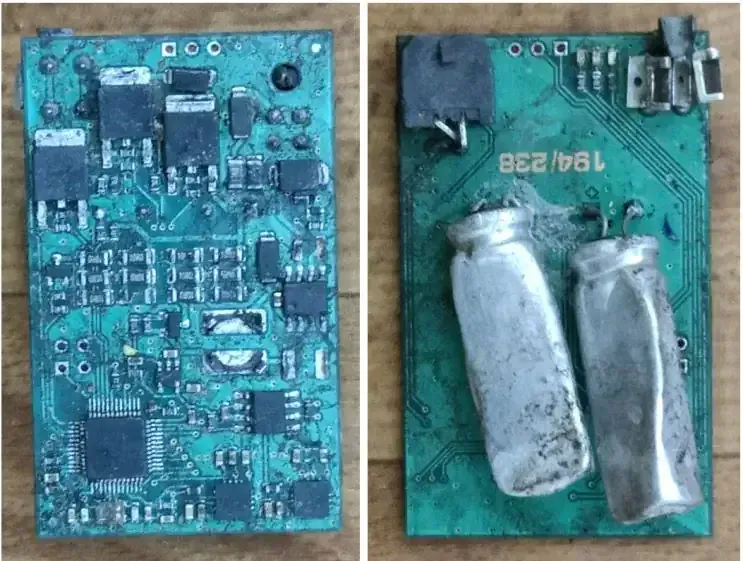
STM32 microcontroller recovered from a Russian Lancet loitering munition. Source: War & Sanctions.
The presence of Western electronic components in Russian military systems has become one of the central issues in export control enforcement since 2022. Subsequent investigations have shown that preventing the diversion of dual-use electronics remains a significant challenge, as international procurement and supply networks have rapidly adapted to sanctions and export restrictions.
One of the earliest comprehensive assessments was RUSI’s 2022 report Silicon Lifeline: Western Electronics at the Heart of Russia’s War Machine, produced in cooperation with Conflict Armament Research (CAR). Based on the examination of 27 Russian weapons systems, the study documented more than 450 types of foreign electronic components, many originating from Western manufacturers, across missiles, communications equipment, and unmanned platforms.
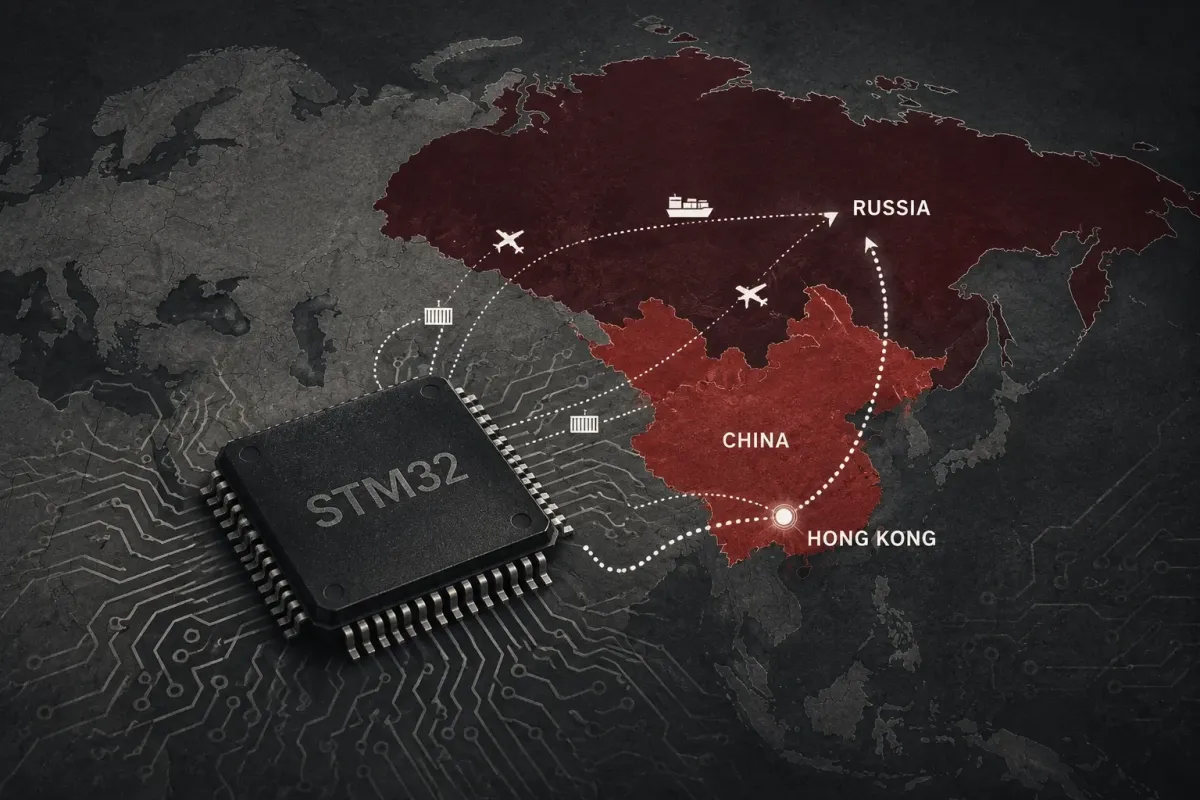
Subsequent investigations by Reuters between 2022 and 2025 reached similar conclusions, showing that Western microelectronics continued to reach Russia despite sanctions. Rather than disappearing, supply chains evolved into increasingly complex procurement networks relying on intermediaries and transit jurisdictions. A Reuters investigation published in August 2024 highlighted China’s growing role as a key hub for the supply of industrial equipment, electronic components, dual-use technologies, and semiconductor products supporting Russia’s defence-industrial sector.
Against this broader backdrop, STM32 microcontrollers provide a representative case study of a widely available dual-use technology. Although designed primarily for commercial applications, these devices can also be integrated into military electronics, including control systems, navigation equipment, communications hardware, and signal-processing modules. Open-source evidence published by Ukrainian authorities, particularly the War & Sanctions database, has repeatedly documented the presence of STM32 microcontrollers and other Western electronic components in recovered Russian military equipment, illustrating the strategic importance of such technologies for export control and sanctions enforcement.
The evidence reviewed in this study suggests that, despite increasingly restrictive export control regimes introduced after 2022, global semiconductor supply chains have remained sufficiently flexible to facilitate the continued movement of dual-use electronics through intermediary jurisdictions. As a result, tracing procurement networks and identifying commercial intermediaries has become an essential component of export control analysis and open-source investigations.
Export Controls and Sanctions Framework
The STM32F407VET6 microcontroller is not individually listed as a prohibited item under U.S. or European Union sanctions. Instead, it falls within the broader category of dual-use electronics - commercial technologies that may also have military applications and are therefore subject to export control regulations depending on their technical characteristics, end user, and intended end use.
Within the European Union, exports of dual-use items are governed by Regulation (EU) 2021/821, which establishes a common framework for the export, brokering, transit, and technical assistance of sensitive technologies, including semiconductor devices, microprocessors, and microcontrollers.
Following Russia’s full-scale invasion of Ukraine in 2022, these controls were further reinforced through successive amendments to Council Regulation (EU) No 833/2014, significantly expanding restrictions on the export of advanced electronics and other technologies that could contribute to Russia’s military and technological capabilities.
The broader implementation of these restrictions forms part of the European Union’s sanctions regime against Russia.
The United States applies a comparable regulatory framework through the Export Administration Regulations (EAR), administered by the Bureau of Industry and Security (BIS). Depending on their technical specifications, general-purpose microcontrollers may fall under Export Control Classification Number (ECCN) 3A991. In addition, Part 744 of the EAR imposes licensing requirements and export restrictions where there is a risk of military end use or military end users.
While the STM32F407VET6 itself is not comprehensively prohibited, its export is subject to a risk-based regulatory framework that considers not only the technical characteristics of the product but also the identity of the recipient, the intended end use, and the potential for diversion through intermediary jurisdictions.
The enforcement of these controls increasingly targets companies involved in sanctions evasion. One example is JINMINGSHENG TECHNOLOGY (HK) CO., LIMITED, which has been designated by the U.S. Department of the Treasury’s Office of Foreign Assets Control (OFAC) under Executive Order 14024 for its role in supplying electronic components that support Russia’s defence-industrial sector.
STMicroelectronics has publicly stated that it suspended its business activities in Russia and complies with applicable U.S. and EU sanctions and export control regulations introduced after February 2022. Nevertheless, open-source investigations and technical examinations of Russian military equipment continue to identify STMicroelectronics components in Russian weapons systems. These findings suggest that such components continue to reach Russia through complex international procurement networks involving intermediaries, re-exporters, and third-country transit hubs rather than through direct commercial sales.
Methodology: Reconstructing International Supply Chains Using OSINT and Trade Data
This study reconstructs the international supply chains through which STM32F407VET6 microcontrollers continued to reach Russian importers following Russia’s full-scale invasion of Ukraine in 2022. Rather than attempting to document every individual shipment, the analysis seeks to identify recurring procurement patterns, commercial relationships, intermediary jurisdictions, and international trade routes that collectively explain how these dual-use electronic components continued to reach Russia despite increasingly stringent export controls.
The research combines multiple categories of open-source information, including customs declarations, bills of lading (BoL), international trade statistics, corporate registries, sanctions databases, and publicly available company records. Shipment-level information was obtained primarily from commercial Trade Intelligence Platforms, including TradeSparq and 52WMB , which aggregate customs records, shipping documentation, import-export statistics, and other logistics data from multiple jurisdictions.
Because no single commercial trade database provides complete visibility into global commerce, data from multiple platforms were systematically cross-referenced and compared. This approach improves overall coverage, helps verify shipment records across independent sources, and makes it possible to identify recurring commercial relationships between manufacturers, exporters, intermediaries, logistics providers, and Russian importers. Corporate registries and sanctions databases were used to verify company identities, ownership structures, and commercial links identified through customs records.
The resulting dataset should be understood as an analytical representation of international trade flows rather than a complete record of global commerce. Commercial customs databases are inherently incomplete and reflect differences in national reporting requirements, customs disclosure policies, shipment documentation practices, and the availability of public trade records. Consequently, the visibility of individual transactions varies considerably between jurisdictions.
Electronic components present an additional methodological challenge because customs classifications are not applied consistently across countries. The STM32F407VET6 microcontroller may be declared under HS 854231 (electronic integrated circuits: processors and controllers), while similar products also frequently appear under HS 854239 (other electronic integrated circuits). In practice, identical components may also be recorded under abbreviated part numbers, generic product descriptions, manufacturer names, or commercial descriptions that differ from the original product designation.
For this reason, the analysis does not rely solely on HS classification. Each shipment was evaluated using multiple indicators, including HS codes, product descriptions, manufacturer references, part numbers, shipment chronology, trading counterparties, and recurring commercial relationships. Applying multiple analytical criteria reduces the likelihood of misclassification and provides a more reliable basis for reconstructing international procurement networks.
It should also be recognised that no commercial customs database captures every international shipment. Many customs records remain confidential or are unavailable to the public, while identical products may be declared under different descriptions or tariff classifications depending on national customs practices. Consequently, even comprehensive searches using multiple HS codes, product names, manufacturer references, and part numbers cannot guarantee the identification of every shipment involving a specific electronic component.
Accordingly, the findings presented in this study should be interpreted as an evidence-based reconstruction of probable international supply chains rather than an exhaustive inventory of global trade. Although individual shipments may be absent from publicly available datasets, the convergence of customs records, shipping documentation, corporate information, sanctions data, and other open sources provides a robust evidentiary basis for identifying key commercial actors, recurring procurement patterns, intermediary jurisdictions, and the principal routes through which STM32 microcontrollers continued to reach Russian importers after 2022.
##Reconstructing STM32 Supply Chains to the Russian Federation (2022–2026)
This study examines the STM32F407VET6 microcontroller manufactured by STMicroelectronics as a case study of a widely available dual-use electronic component. Although primarily used in civilian and industrial applications, components of this type may also be incorporated into more advanced technical systems.
Because international electronics trade is characterised by inconsistent product descriptions and varying customs declaration practices, the analysis was not restricted to records explicitly identifying the STM32F407VET6 model. Instead, it included related trade records containing alternative descriptions, tariff classifications, manufacturer references, and other identifying characteristics that enabled the tracing of STM32-family components through international supply networks.
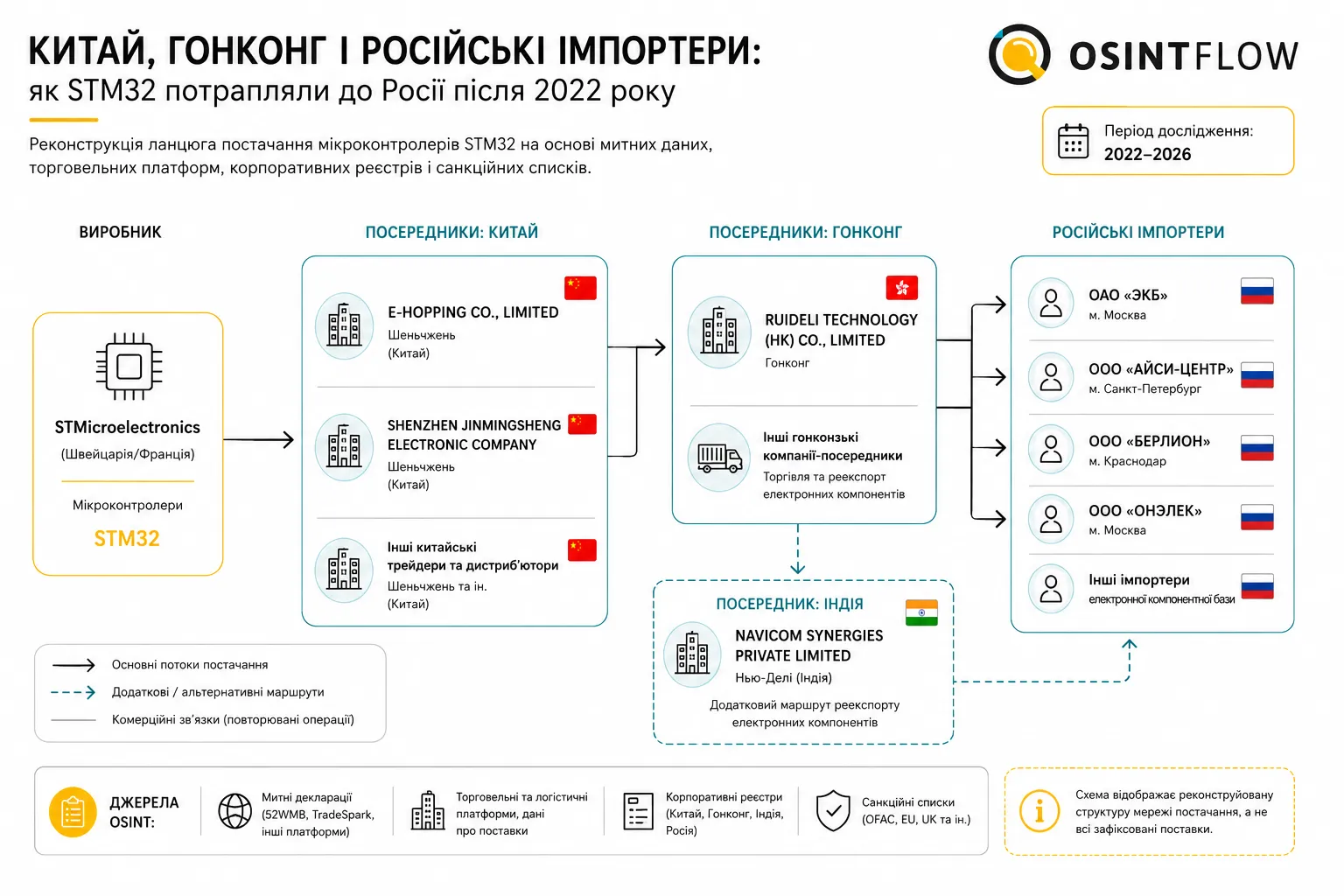
To reconstruct these procurement networks, the study analyses three companies whose trading activity reflects recurring patterns in the movement of electronic components to Russian importers following Russia’s full-scale invasion of Ukraine. These companies were selected based on the availability of open-source trade data, repeated shipment activity, a significant share of transactions declared under HS code 85423990, and established commercial links with Russian entities involved in electronic component procurement.
While these cases do not encompass every possible supply channel, they provide insight into the mechanisms through which international procurement networks adapted after 2022 and continued to facilitate access to electronic components despite expanded export controls and sanctions.
Analysis of these companies’ activities reveals the role of China- and Hong Kong-based trading intermediaries in facilitating the movement of electronic components to the Russian Federation, as well as the commercial relationships connecting exporters, intermediaries, and Russian importers.
Based on available customs and trade records, the combined volume of STM32-related component shipments linked to the companies examined in this study is estimated to exceed 300,000 units, with a total declared value of more than USD 2.5 million between 1 January 2022 and 30 May 2026.
Due to differences in customs classification systems and commercial declaration practices, these figures include records containing different product descriptions and tariff classifications that may correspond to STM32-family components. Therefore, the reported figures should be understood as an estimate derived from the analysed dataset rather than a comprehensive record of all STM32-related shipments to the Russian Federation.
Trade activity peaked in 2023, when both the number of recorded transactions and estimated shipment volumes reached their highest levels. Although activity declined in subsequent years, available records do not indicate a complete interruption of these supply networks during 2025–2026.
E-HOPPING CO., LIMITED
E-HOPPING CO., LIMITED is a Hong Kong-based trading company whose activities, based on available open-source trade data, indicate its role as an intermediary within international supply networks through which electronic components continued to reach Russian importers after Russia’s full-scale invasion of Ukraine.
The company was registered in Hong Kong in April 2023, according to records published by the Hong Kong Companies Registry. Its documented trading activity corresponds to the period when international export controls and restrictions on technology-related trade with the Russian Federation had already been significantly expanded.
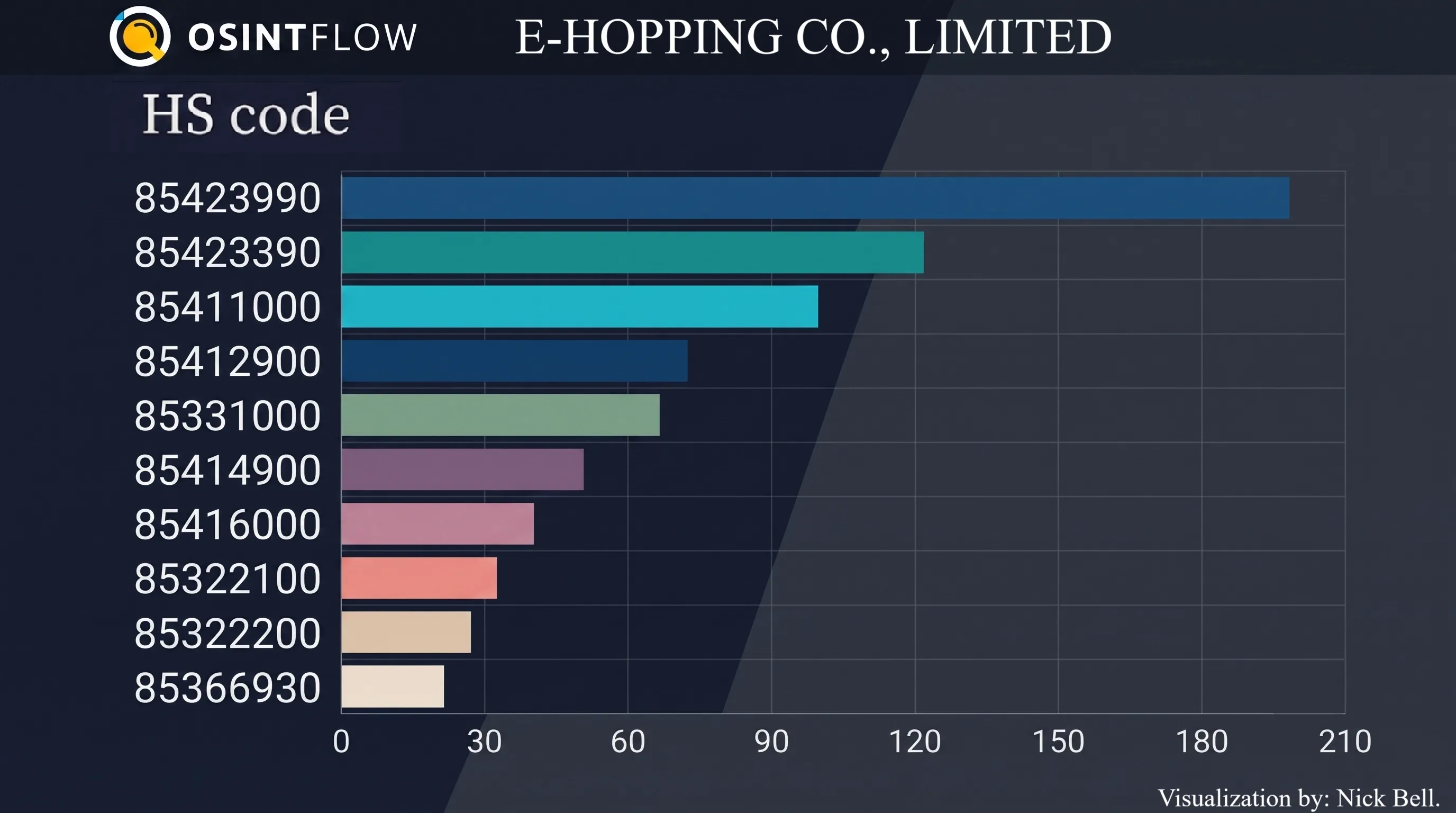
Analysis of available trade data indicates that E-HOPPING CO., LIMITED primarily operated as a distributor of electronic components to Russian importers. The largest share of analysed trade records relates to integrated circuits classified under HS code 85423990 (198 records), followed by other integrated circuits (HS 85423390 — 13 records), semiconductor diodes (HS 85411000 — 8 records), and other semiconductor devices (HS 85412900 — 7 records).
The predominance of integrated circuits and semiconductor-related products within the company’s recorded transactions indicates a specialization in electronic component distribution.
Of particular relevance is HS code 85423990 (8542399010), which covers a broad category of modern integrated circuits, including microcontrollers from the STM32 family. However, reconstruction of electronic component supply networks requires consideration of inconsistencies in global customs reporting practices. Identical or similar components may be declared under different HS classifications, abbreviated descriptions, or generic product categories depending on the jurisdiction and documentation practices of exporters.
Therefore, the reconstruction of E-HOPPING CO., LIMITED’s supply links was based not only on tariff classifications, but also on a combination of product descriptions, specific component models, shipment chronology, recurring counterparties, and commercial relationships between participants in the broader supply network.
Available trade platform data shows that E-HOPPING CO., LIMITED maintained concentrated commercial relationships with a limited number of Russian importers. The largest share of recorded transactions involved OAO «ЭКБ» (128 records; 47.41%) and ООО «АЙСИ-ЦЕНТР» (98 records; 36.30%). Other recurring Russian counterparties included ООО «ЭЛЕКТРОН КОМПОНЕНТ» (31 records; 11.48%), AO «ТРЭК» (6 records; 2.22%), and ООО «ТЕХНОСТЕК» (4 records; 1.48%).
Together, these five companies account for more than 95% of the analysed trade records. This concentration indicates established commercial relationships between E-HOPPING CO., LIMITED and a relatively narrow group of Russian electronic component importers.
At the same time, these figures should be interpreted within the limitations of available commercial trade datasets, as customs and logistics platforms may contain duplicate company profiles or records aggregated from different underlying data sources.
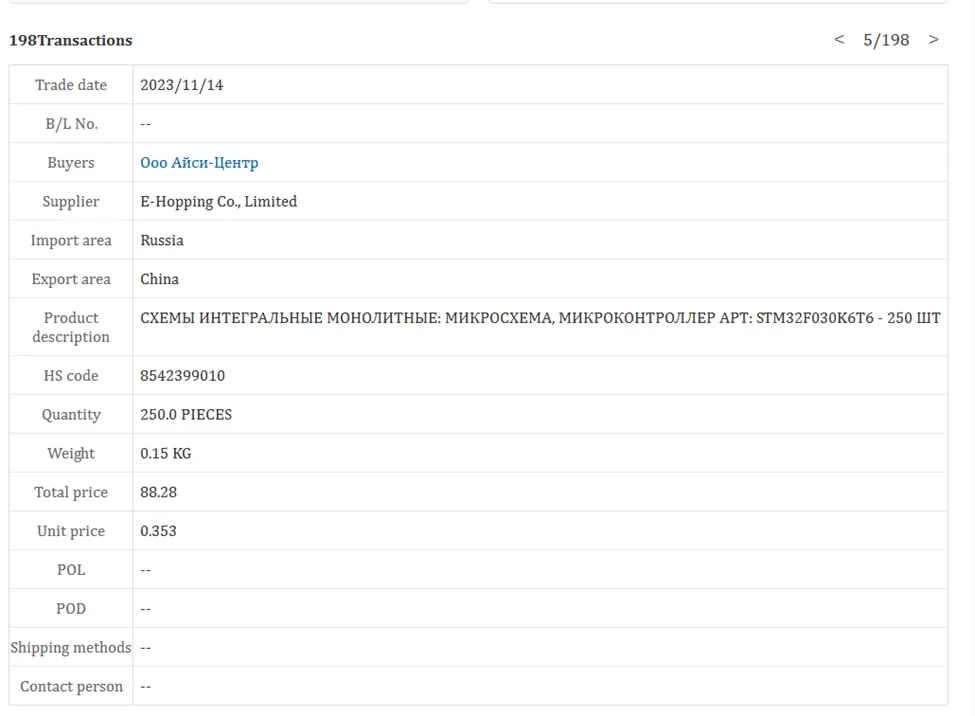
The analysis also identified specific shipment records involving STMicroelectronics products. In particular, trade data contains a transaction dated 14 November 2023 in which E-HOPPING CO., LIMITED supplied STM32F030K6T6 microcontrollers to ООО «АЙСИ-ЦЕНТР» (Russian Federation) under HS code 8542399010.
This transaction provides a direct example of the company’s involvement in supplying STMicroelectronics products to Russian importers and demonstrates the operation of intermediary-based procurement networks at the level of an individual commercial shipment.
The company’s trading activity also demonstrates changes over time. During 2023–2024, the main Russian buyers identified in available records were OAO «ЭКБ», ООО «АЙСИ-ЦЕНТР», and ООО «ЭЛЕКТРОН КОМПОНЕНТ». In 2025, available trade data indicates shipments involving ООО «Электроника Импорт Экспорт».
According to available information, five transactions were recorded in 2025 involving the supply of approximately 100,000 electronic components with a combined weight of around 994 kg. Although these shipments involved aluminium electrolytic capacitors rather than STM32 microcontrollers, they demonstrate that E-HOPPING CO., LIMITED continued commercial cooperation with Russian electronic component importers after the expansion of international sanctions and export restrictions.
Overall, the available trade data place E-HOPPING CO., LIMITED among the intermediary companies involved in the post-2022 flow of electronic components to Russian importers. The company’s activity was characterised by a strong focus on integrated circuits, repeated transactions with a limited group of Russian counterparties, and documented shipments of STMicroelectronics microcontrollers, illustrating the role of intermediary trading firms in maintaining access to electronic components after the introduction of expanded export controls.
RUIDELI TECHNOLOGY (HK) CO., LIMITED
According to the official Hong Kong Companies Registry, RUIDELI TECHNOLOGY (HK) CO., LIMITED (瑞德利科技(香港)有限公司) was registered on 1 August 2023 (registration number 3304329).
RUIDELI TECHNOLOGY (HK) CO., LIMITED is a Hong Kong-based trading company whose activities, based on available open-source trade and customs logistics data, indicate its role as an intermediary within international supply networks through which electronic components continued to reach Russian importers after Russia’s full-scale invasion of Ukraine. Available trade records identify the company as an exporter of integrated circuits, microcontrollers, and other semiconductor components supplied to Russian counterparties.
Analysis of available trade data indicates that RUIDELI TECHNOLOGY (HK) CO., LIMITED primarily focused on the distribution of electronic components to Russian importers. The largest share of recorded transactions relates to integrated circuits classified under HS code 85423990 (1,513 records), followed by semiconductor diodes (HS 85411000 — 53 records) and other semiconductor devices (HS 85412900 — 47 records).
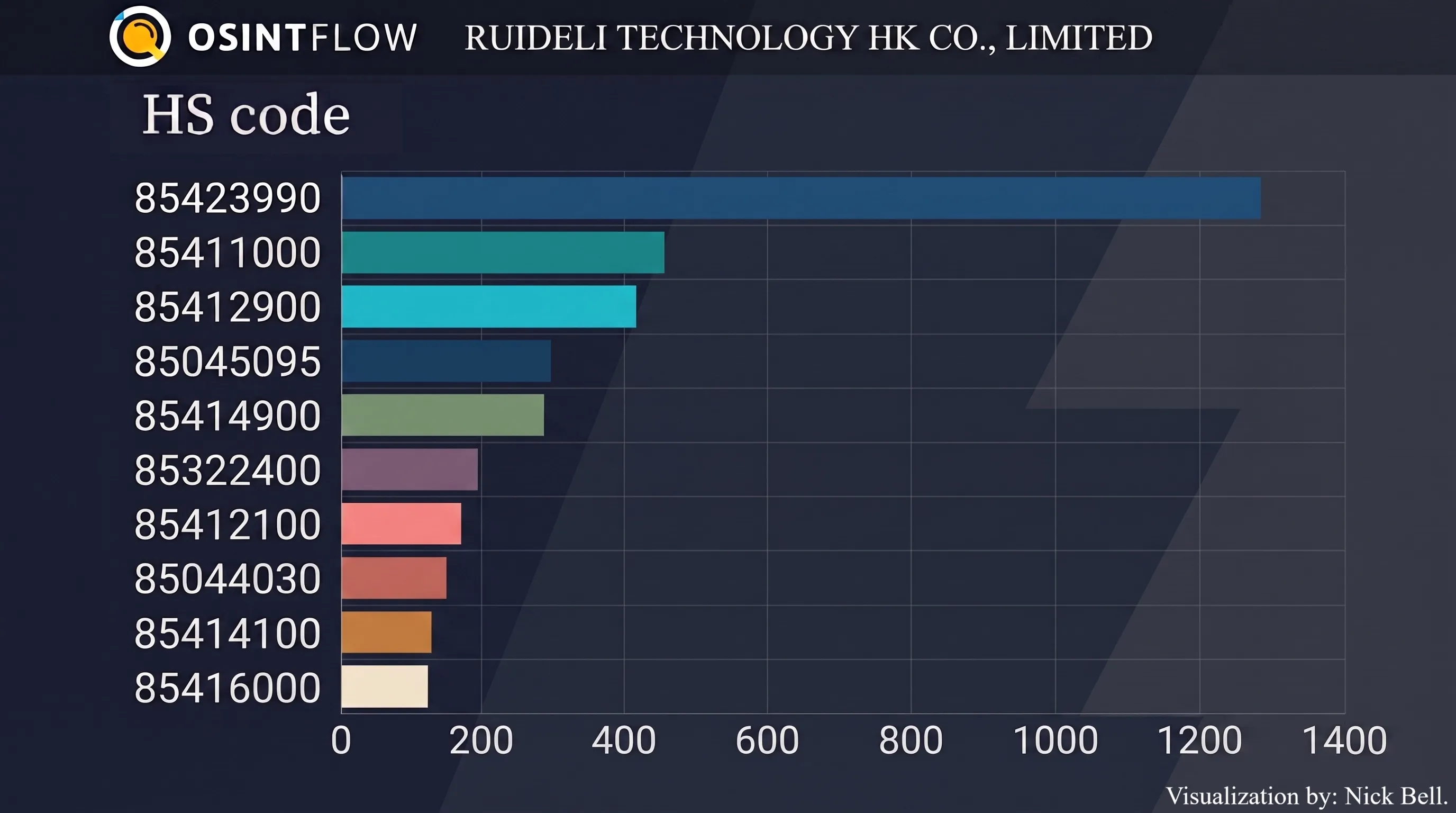
According to customs and logistics data, RUIDELI TECHNOLOGY (HK) CO., LIMITED is associated with 2,019 recorded trade transactions.
The largest number of recorded transactions involved three Russian counterparties: ООО «БЕРЛИОН», ООО «АЙСИ-ЦЕНТР», and OAO «ЭКБ». The first recorded transaction involving ООО «БЕРЛИОН» dates to 9 October 2023, with this company accounting for 703 transactions (34.82%) of RUIDELI’s recorded shipments.
The first recorded transaction involving ООО «АЙСИ-ЦЕНТР» occurred on 19 December 2023, accounting for 668 transactions (33.09%). OAO «ЭКБ» appears in trade records from 26 December 2023, with 646 recorded transactions (32.00%). Additional shipments were identified involving ООО «ОНЭЛЕК», accounting for 2 transactions (0.10%), the first of which was recorded on 25 December 2023.
More than 99.9% of the analysed trade records are concentrated among three Russian companies — ООО «БЕРЛИОН», ООО «АЙСИ-ЦЕНТР», and OAO «ЭКБ». This concentration indicates established commercial relationships between RUIDELI TECHNOLOGY (HK) CO., LIMITED and a limited group of Russian electronic component importers.
The analysis also identified specific examples of electronic component shipments. One such transaction is presented below based on available customs declaration and trade record data.
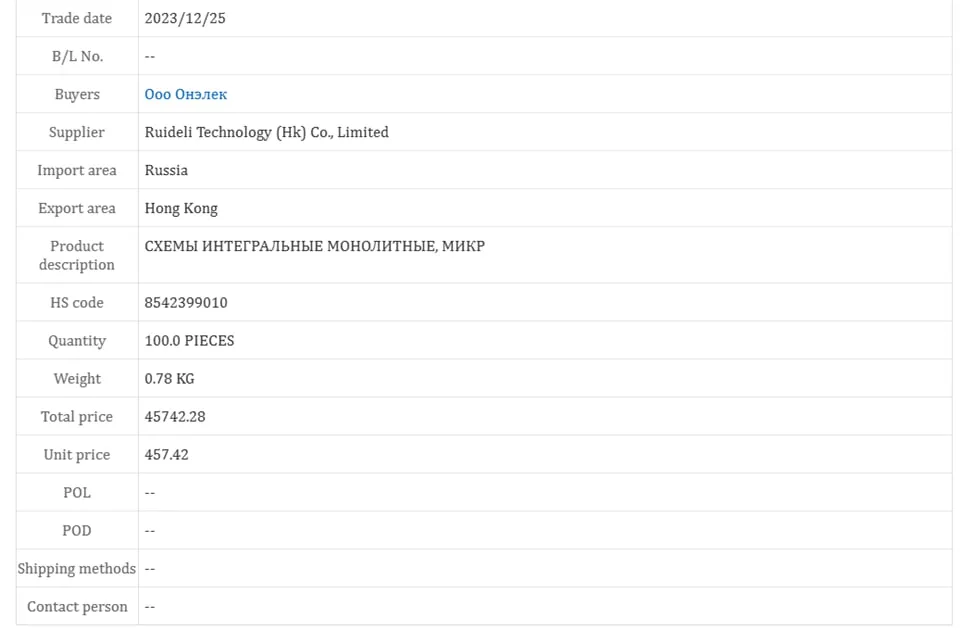
Trade records identify ООО «БЕРЛИОН» and ООО «ОНЭЛЕК» as Russian importers associated with shipments from RUIDELI TECHNOLOGY (HK) CO., LIMITED. A review of available international sanctions databases did not identify RUIDELI TECHNOLOGY (HK) CO., LIMITED as a separately designated entity. However, one of its Russian counterparties, ООО «ОНЭЛЕК», is subject to international sanctions.
Corporate registry records indicate that ООО «БЕРЛИОН» and ООО «ОНЭЛЕК» are connected through overlapping ownership and management structures associated with the Akulov family.
Ivan Sergeyevich Akulov serves as the General Director of ООО «ОНЭЛЕК» and ООО «ОНЭЛЕК ВПК».
Olesya Anatolyevna Akulova serves as the General Director of ООО «БЕРЛИОН» and is identified as the sole owner of ООО «БЕРЛИОН», ООО «ОНЭЛЕК», and ООО «ОНЭЛЕК ВПК».
These corporate links indicate that ООО «БЕРЛИОН» and ООО «ОНЭЛЕК» are not independent counterparties but are connected through a shared ownership and management structure.
Taken together, trade records, customs data, logistics information, and corporate registry records indicate that RUIDELI TECHNOLOGY (HK) CO., LIMITED operated as an intermediary within electronic component supply networks involving Russian importers after 2022.
The company’s trade profile, characterised by a strong focus on integrated circuits, repeated transactions with a limited group of Russian counterparties, and links to entities associated with the «ОНЭЛЕК» group — including a company subject to international sanctions — place RUIDELI TECHNOLOGY (HK) CO., LIMITED within the broader network of intermediary firms involved in supplying electronic components to the Russian Federation.
At the same time, available open-source information does not indicate that RUIDELI TECHNOLOGY (HK) CO., LIMITED itself is subject to international sanctions or that its shipments were conducted with a confirmed intention of integration into military systems.
The concentration of integrated circuits within RUIDELI TECHNOLOGY (HK) CO., LIMITED’s trade profile, its extensive commercial links with a limited number of Russian importers, and the presence of counterparties associated with the «ОНЭЛЕК» group — including an entity subject to international sanctions — indicate that the company represents a significant intermediary within reconstructed electronic component supply networks connected to the Russian Federation.
At the same time, available open-source information does not indicate that RUIDELI TECHNOLOGY (HK) CO., LIMITED itself is subject to international sanctions or that its shipments were conducted with a confirmed purpose of integration into military equipment.
JINMINGSHENG TECHNOLOGY (HK) CO., LIMITED
According to the Hong Kong company registry, JINMINGSHENG TECHNOLOGY (HK) CO., LIMITED (金銘盛科技(香港)有限公司) was incorporated on 9 December 2008 as a private company limited by shares. The company’s previous registration number was 1292952, while its current Business Registration Number (BRN) is 50093445. As of July 2026, the company remains listed as active (LIVE).
Analysis of available trade and customs logistics data indicates that JINMINGSHENG TECHNOLOGY (HK) CO., LIMITED operates as an exporter of electronic components and appears within international supply networks connected to Russian importers following Russia’s full-scale invasion of Ukraine.
In commercial trade intelligence platforms, including Volza and TradeSparq, records related to this company may appear under the name SHENZHEN JINMINGSHENG ELECTRONIC COMPANY. This reflects differences in company name formatting, data aggregation methods, and source records used by commercial trade databases, rather than a confirmed change in the company’s legal identity.
Available trade records indicate that the company’s primary activity involves the distribution of electronic components. The largest share of recorded shipments relates to integrated circuits classified under HS code 85423990 (1,176 shipments).
Additional recorded categories include inductive components (HS 850450 — 66 shipments), other semiconductor devices (HS 85412900 — 62 shipments), semiconductor diodes (HS 85411000 — 54 shipments), photosensitive semiconductor devices (HS 85414900 — 42 shipments), variable resistors (HS 85334000 — 40 shipments), static converters (HS 85044000 — 32 shipments), fixed resistors (HS 85331000 — 32 shipments), light-emitting diodes (HS 85414100 — 28 shipments), and other semiconductor devices (HS 85412100 — 24 shipments).
The composition of recorded transactions indicates that JINMINGSHENG TECHNOLOGY (HK) CO., LIMITED specialises in international trade of electronic components, with integrated circuits representing the dominant category within its recorded export activity.
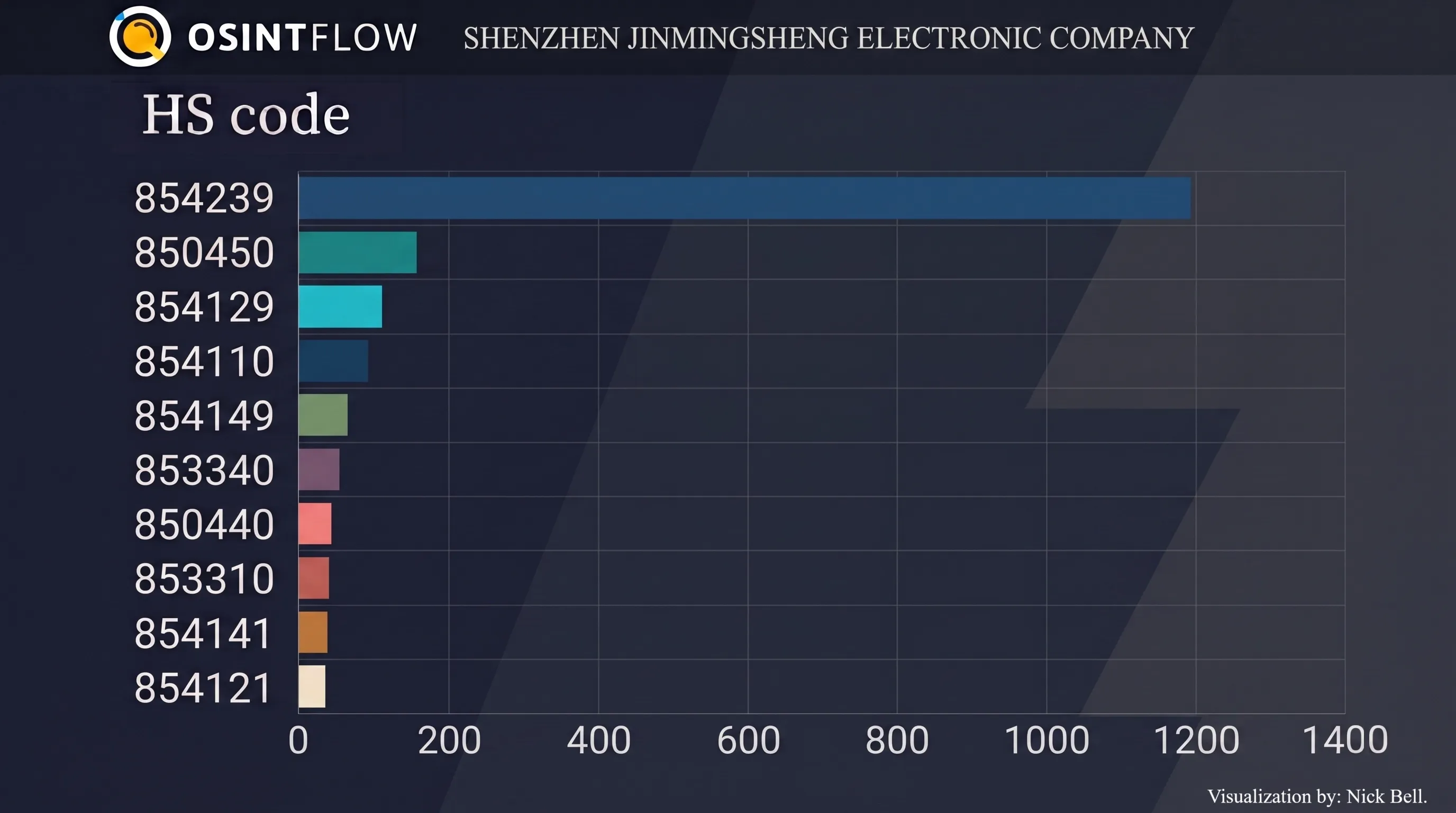
HS code 85423990 (8542399010) is of particular relevance because it covers a broad category of modern integrated circuits, including STM32-family microcontrollers. However, reconstructing electronic component supply networks requires consideration of inconsistencies in customs classification and commercial reporting practices.
Identical or similar components may be declared under different HS codes or generic product descriptions depending on the jurisdiction, exporter documentation, and customs procedures.
Therefore, the analysis did not rely solely on tariff classifications. Shipment identification was based on multiple indicators, including product descriptions, component models, recurring shipment patterns, counterparties, and relationships between participants within the broader commercial network.
Available trade and customs logistics data indicate that JINMINGSHENG TECHNOLOGY (HK) CO., LIMITED maintained regular shipments of electronic components to the Russian Federation, with ООО «ОНЭЛЕК» identified as its primary Russian counterparty.
Similar commercial links are also reflected in other trade intelligence platforms, where the company appears among suppliers associated with ООО «ОНЭЛЕК» across several electronic component categories, including HS 8542 (integrated circuits), HS 8541 (semiconductor devices), and HS 8504 (electrical transformers, static converters, and related equipment).
Available shipment data indicate that the highest level of recorded activity occurred in 2023, followed by a decline in the number of identified shipments. However, available records do not indicate a complete cessation of export activity. The primary route identified in the analysed records follows the pattern China/Hong Kong → Russian Federation.
JINMINGSHENG TECHNOLOGY (HK) CO., LIMITED is included in several international sanctions-related databases. The company is listed in the War & Sanctions database maintained by the Main Directorate of Intelligence of the Ministry of Defence of Ukraine (https://war-sanctions.gur.gov.ua/en/sanctions/companies/12858) and in OpenSanctions (https://www.opensanctions.org/entities/NK-jQ4sBthBwV8JD8V2B4U8ZS/), a platform that aggregates sanctions information from multiple jurisdictions.
The significance of this case is further reinforced by independent investigative research. The Royal United Services Institute (RUSI) report Silicon Lifeline: Western Electronics at the Heart of Russia’s War Machine and The Insider investigation How Western Chips Continue to Reach Russia and End Up in Weapons identify supply networks through which foreign electronic components continued to reach Russian entities, including networks involving JINMINGSHENG TECHNOLOGY (HK) CO., LIMITED and ООО «ОНЭЛЕК».
According to these investigations, shipments involving the identified companies in 2023 included components manufactured by NXP Semiconductors that were later identified among electronic components recovered from the Russian «Kub» loitering munition.
The combination of trade records, customs and logistics data, corporate information, sanctions records, and independent investigations indicates that JINMINGSHENG TECHNOLOGY (HK) CO., LIMITED represents a significant intermediary within reconstructed electronic component supply networks connected to the Russian Federation.
The company’s role is supported by several indicators: its specialization in electronic component exports, the predominance of integrated circuits within its recorded shipments, sustained commercial relationships with Russian importers, documented examples of component deliveries, its presence in sanctions databases, and its identification in independent investigations examining the continued movement of foreign electronic components into Russia after 2022.
At the same time, available open-source information does not establish the end-use of every individual shipment and does not independently confirm that all components supplied by the company were incorporated into military systems.
India: An Additional Node in the Supply Network
In addition to Chinese and Hong Kong-based trading intermediaries, the reconstruction of the supply network identified India as another geographic node involved in the flow of electronic components to the Russian Federation.
Among the foreign suppliers identified in the analysis is NAVICOM SYNERGIES PRIVATE LIMITED, an Indian trading company appearing in available trade records as an exporter of electronic components to several Russian importers, including ONELEK LLC, NPK FOTON LLC, RADIODETAL LLC, DIALCOM-EC LLC, NIPPU LLC, ELEKTRON LLC, and SFERA 3 LLC.
The available trade records are dominated by HS Code 854239 (electronic integrated circuits), while the remaining transactions fall under related categories of electronic components.
The commercial links involving NAVICOM SYNERGIES PRIVATE LIMITED complement the reconstructed supply network and suggest that, following the introduction of export restrictions in 2022, supply routes for electronic components to Russia became more geographically diversified. Rather than relying solely on Chinese and Hong Kong-based intermediaries, the reconstructed network indicates the involvement of companies from other Asian jurisdictions, including India.
Common Patterns in Reconstructed Electronic Component Supply Networks
A comparison of the reconstructed supply networks reveals several recurring patterns in international electronic component trade connected to Russian import demand after 2022.
Although RUIDELI TECHNOLOGY (HK) CO., LIMITED, E-HOPPING CO., LIMITED, and JINMINGSHENG TECHNOLOGY (HK) CO., LIMITED differ in scale, shipment volumes, and commercial relationships, available trade data indicate a common pattern in their role within these networks: each functioned as an intermediary trading entity connecting Asian electronic component suppliers with Russian importers.
Across all three cases, integrated circuits classified under HS code 85423990 represent the dominant category of recorded shipments. This classification covers a broad range of electronic components, including STM32-family microcontrollers. The recurring presence of other semiconductor devices, electronic modules, and power-related components indicates that these companies operated as suppliers of broader electronic component portfolios rather than being involved in isolated transactions involving individual products.
The reconstructed networks also show a high concentration of shipments among a limited number of Russian counterparties. ООО «ЭКБ», ООО «АЙСИ-ЦЕНТР», ООО «БЕРЛИОН», АО «ТРЭК», and ООО «ОНЭЛЕК» appear repeatedly across the analysed records, indicating sustained commercial relationships between intermediary exporters and a relatively small group of Russian electronic component importers.
Another recurring feature is the use of intermediary jurisdictions and flexible commercial routes. In addition to companies registered in Hong Kong and mainland China, the analysed trade records indicate connections involving other international trading locations, including Turkey and additional intermediary jurisdictions. These patterns illustrate how electronic component procurement networks adapted to a more restrictive export-control environment following the introduction of expanded sanctions after 2022.
The findings indicate that international supply networks for electronic components did not cease operating after the introduction of broader sanctions and export restrictions. Instead, they underwent structural adaptation, characterised by the increased role of specialised trading companies, intermediary jurisdictions, and multi-layered commercial relationships between exporters and Russian buyers.
Summary
This research reconstructs several international supply networks through which STM32-family electronic components continued to reach Russian importers after 2022. While the identified cases do not represent the entirety of global trade flows, they provide evidence of recurring procurement patterns, intermediary structures, and commercial relationships that enabled continued access to foreign electronic components.
The analysis of trade records, customs data, corporate information, and sanctions-related sources shows that electronic component supply networks adapted rather than disappeared following the introduction of expanded export controls. A key feature of this adaptation was the increased role of specialised trading companies, intermediary jurisdictions, and multi-layered commercial relationships connecting Asian suppliers with Russian importers.
Across the reconstructed cases, several common characteristics were identified: the concentration of shipments among a limited number of Russian importers, the dominance of integrated circuits within recorded transactions, the use of Hong Kong- and China-based intermediaries, and the persistence of alternative commercial routes after 2022.
The findings demonstrate that open-source trade intelligence can be used to move beyond individual shipment identification and reconstruct broader procurement networks. Combining customs records, trade databases, corporate registries, and sanctions information provides a practical framework for analysing how sensitive technology supply chains evolve under conditions of export restrictions.